Kurt Vonnegut’s Player Piano, written more than half a century ago, eerily presages the fears, anxieties, and ethical dilemmas about sweeping automation currently in full swing regarding AI. One era’s dystopian imagination could be another’s portrait of bleak realism.
The boundless possibilities of GenAI to redefine entire sectors, processes, as well as upturn jobs, pose a unique challenge – and if utilized well, an opportunity as well.
From the scramble for regulations to debates over ethical implications, AI has captured the attention of policy-makers and entrepreneurs alike. This is a critical juncture in technology governance.
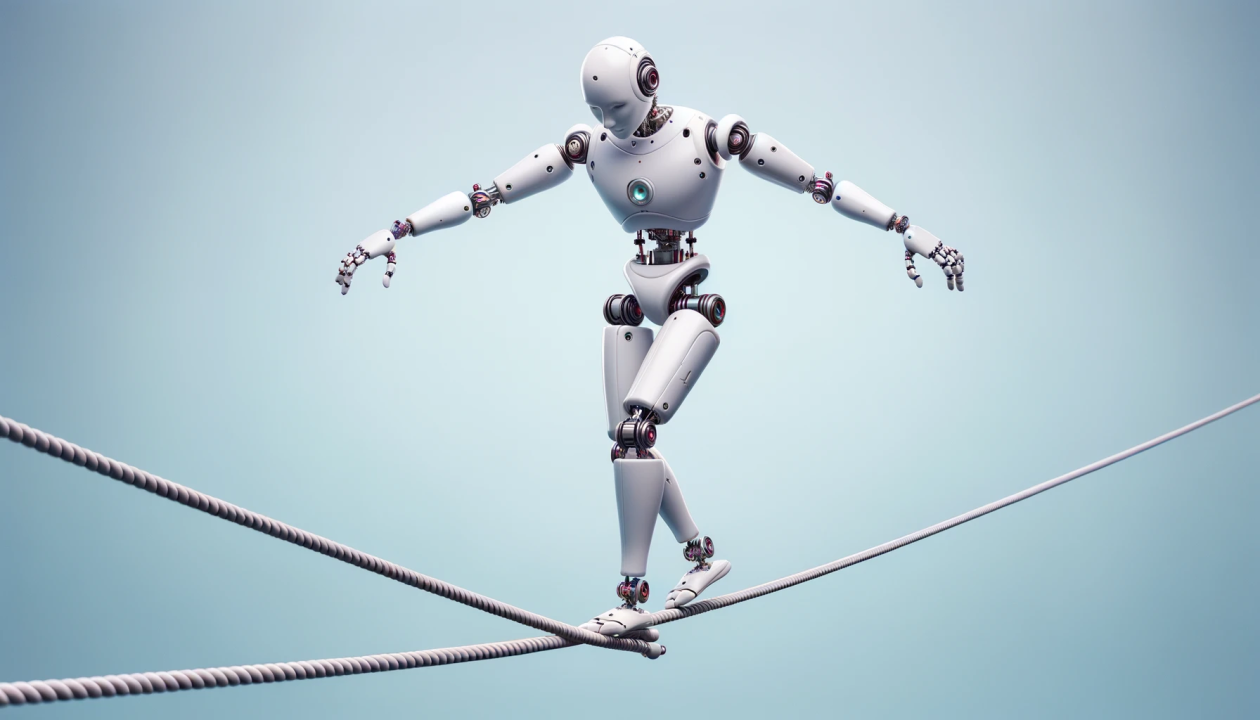
The challenge is to regulate best a technology whose hyper-fast pace and decentralized nature would surpass Moore’s Law.
AI looms large in the biggest collective challenges confronting the globe, along with Climate Change and geopolitical instability.
With the advent of the internet, the world has become more interconnected than ever before. However, simultaneously the tipping points, stresses, fragmentation, and polarization have also increased.
It’s Complex!
The complexity of supply chains and logistic fulfilment in a dynamic marketplace – and often its self-adjusting mechanism with numerous nodes – is best illustrated by the short essay ‘I, Pencil’ by the American economist Leonard Read.
However, there’s a downside to all complex systems. Any disruption anywhere has unforeseen consequences everywhere, leading to a spiralling cascade and free fall.
The hidden power of asymmetry and ‘Butterfly Effects’ can only be overlooked at one’s peril. Supply chain disruptions during the pandemic and the ongoing Red Sea blockade by Yemen’s Houthi militants represent these risks.
The World’s biggest shipping companies such as Maersk and Hapag Lloyd are now taking the arduously circuitous and costly route via the Cape of Good Hope, which was abandoned ever since the construction of the Suez Canal more than a century ago.
The alarming convergence of risks – social, geopolitical, technological, as well as ecological – does require urgent solutions with a fresh maverick approach.
Geospatial visualization and AI-based predictive analytics can be a great help here in monitoring and mitigating risks.
At the ongoing World Economic Forum 2024, Gen.AI and what it portends dominates the discourse.
Jake Sullivan, the United States National Security Advisor, recently spoke about the need to keep up investments in critical technologies, and more crucially the ‘scope of cooperation between US and China on minimizing AI risks’.
Nothing can better emphasize the need for issue-based alliances and coalitions working towards a common goal.
The forum’s recent White Paper ‘Shaping Cooperation in a Fragmenting World’, points out US-Soviet issue-based cooperation, notably in smallpox eradication and nuclear control, even at the peak of the Cold War. This is the spirit needed from space sustainability to disaster management.
The Third Pillar
Robert M. Solow, the brilliant MIT economist, showed that technology transformation is the third – and most crucial – pillar of economics.
Moving beyond Adam Smith and Karl Marx, he painstakingly demonstrated that technology, not labour or capital, is the main source of economic growth.
As a New York Times obituary puts it, “he estimated that technical progress accounted for a surprising 80 per cent of 20th-century American growth”.
In the 21st century, the role of technology, and its impact on individuals and societies has witnessed a manifold increase, especially due to the power of connectivity, computation, and sensor miniaturization.
As AI unveils another vista of progress, it cannot be viewed solely as an instrument for maximizing productivity, efficiency, and speed, but as something constantly interacting with and shaping societies and economies.
There are trade-offs everywhere, but as Andrew Anagnost, President & CEO, Autodesk, says, the benefits of AI outweigh its risks. The way forward lies in harnessing its enormous potential, eliminating externalities, and identifying hidden risks.
Disclaimer: Views Expressed are Author's Own. Geospatial World May or May Not Endorse it