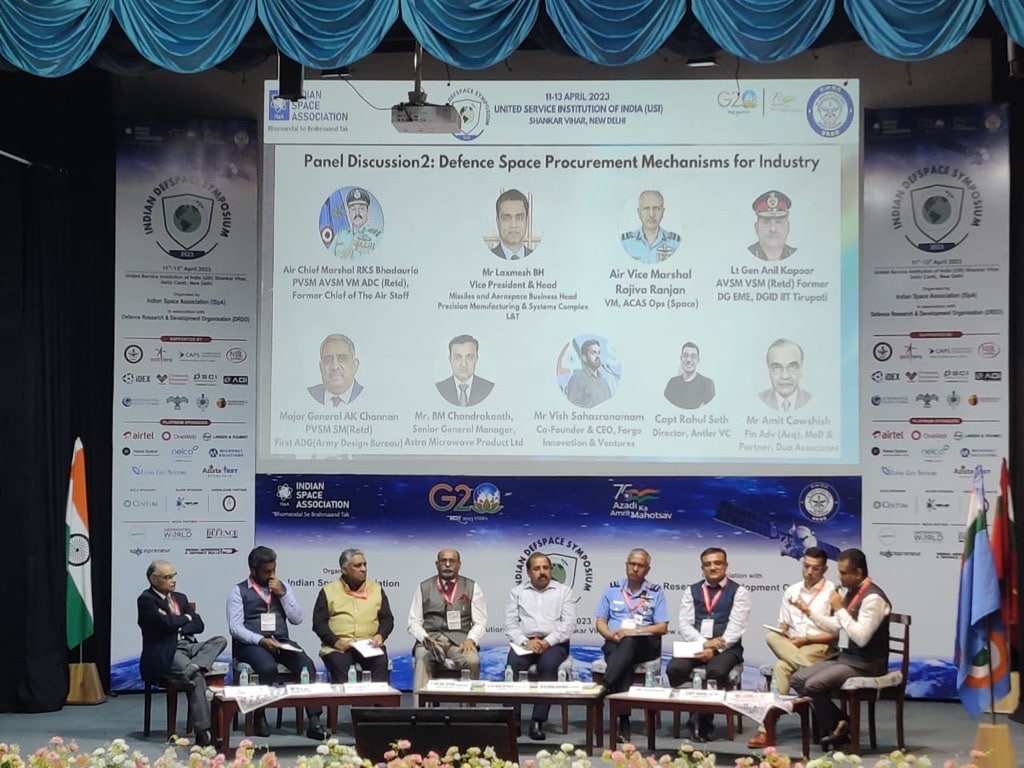
Indian Space Association (ISpA) along with the Defence Research and Development Organisation (DRDO) have organised the first edition of the Indian DefSpa Symposium.
The symposium is stretched over 3 days from April 11-13, to initiate a conversation on how to boost India’s space defence capabilities and how the challenges can be addressed collectively to make India self-reliant.
Day 2 of the symposium had some in-depth discussions between the stakeholders focussing on delivering space domain awareness to enhance military capabilities, expanding partnerships bandwidth, making way for new space operations and developing a Defence Space Strategy in line with the National Space Strategy.
Rajesh Muneshwar, Co-founder and CTO, of Vihaan Spacetech, echoed his thoughts that the Western market invests heavily in the space sector especially in the private sector because they have understood its value of it.
Indian market is still hesitant to invest in space start-ups because space has been for long an alien concept. And to make it more acceptable and promote space start-ups, “We need to develop space investment culture. Government should take the first step in this and the rest will follow. We need more space startup forums.”
According to the recently approved Indian Space Policy 2023, ISRO is going to provide its facilities for the private sector for a small charge and to encourage them to invest in creating new infrastructure.
Dr Sudheer Kumar N, Director, CBPO, ISRO applauds the move and added, “ISRO is the hub of all Space related knowledge and this knowledge needs to be instituted, perpetuated amongst the stakeholders, only then it can truly contribute to capacity building.”
He further added that IITs and NITs are working in silos, and proposed that when the national framework will be constituted, these institutions need to share the knowledge with all. A single window setup is required, so that the user can get data from a single window and information related to the usage of data can be monitored through that.
Vinod Chippalkatti, President SEBU, Centum Group, highlighted the importance of the choice of a unique path in the decision-making process in delivering technology to reduce the gap between the user and provider.
DefSpace Procurement Mechanisms for Industry
Space has become the 5th frontier of defence after Airforce, Navy, Army and Cyber.
Major General AK Channan (Retd), PVSM SM, First ADG (Army Design Bureau) said, “Space needs special procurement policy. Our current procurement system is activity based not innovation based. We need to define proper green fields when it comes to space.”
He emphasized creating project-oriented teams in place of domain specialists. He said the technology is constantly evolving and we need to develop manpower accordingly. When we restrict ourselves to domain specialists, and if the war hits, manpower requirements increase in the field.
Domain specialists are moved to the field, where we need accurate positioning to counter the enemy moves, there we need skilled people to provide the right direction to the domain specialists in the field.
Manpower cannot be developed overnight, thus a system has to be in place to constantly develop skilled manpower, especially in times of need. “We need to procure technology or products that are in the development phase and not the finished ones, where there is no scope of improvement,” said Major General Channan (Retd.).
Dr Ranjana Kaul, Partner, Dua Associates talked about the need for clarity, predictability and a well-drafted composite plan for the Indian armed forces & allied services, and start-ups for the acquisition and timely delivery of products and services.