Climate TRACE

How the global not-for-profit coalition made up of NGOs, technology companies, academia, and former US Vice President and climate leader Al Gore is using earth observation data and AI to bring radical transparency to greenhouse gas emissions.

Climate TRACE

In early April 2022, the Intergovernmental Panel on Climate Change (IPCC) — the UN’s preeminent body on the human-caused climate crisis — released its anxiously anticipated assessment of the action needed to avert climate disaster. News headlines were a unified chorus: the window is rapidly closing to decisively act to reduce emissions and avoid the worst effects of the climate crisis.

Never before has the need been greater for accurate and timely information on the emissions that are being added to Earth’s atmosphere and where they are coming from. Delivering answers to such questions — leveraging earth observation data and AI — is the story of Climate TRACE.


The genesis of a global coalition

The relatively recent proliferation of lower-cost satellites in orbit studying our planet, coupled with advances in AI and machine learning technology, have in recent years made new forms of tech-forward emissions monitoring possible.

In 2019 WattTime, an environmental tech nonprofit, received a grant from Google.org to use satellites to monitor the emissions from the world’s fossil-fueled power plants. The project caught global attention and prompted a response from the world’s emissions monitoring and remote sensing communities: Could we use similar technology-centric approaches to also monitor emissions from the other major emissions-causing sectors of the global economy, such as shipping, industry, aviation, and agriculture?

The short answer was ‘yes.’ And in 2020, Climate TRACE (Tracking Real-time Atmospheric Carbon Emissions) was born. We are a not-for-profit coalition of international organizations made up of NGOs, technology companies, academia, and former US Vice President and climate leader Al Gore. Our collective goal is to bring radical transparency to global emissions monitoring, by pinpointing exactly where emissions are coming from and fill in the critical detail missing in existing greenhouse gas emissions inventories.

Using technology to complement legacy emissions inventories

Greenhouse gas (GHG) inventories are now measured using standardized methods such as a framework developed by the IPCC to identify emissions sources, quantify annual emissions, and track progress toward emissions-reduction commitments and targets.

Much of what we rely on today for these GHG data comes from a patchwork of high-level but often-outdated, country-provided reports. Producing a comprehensive national inventory has historically been a time- and resource-intensive process, putting some countries at a disadvantage. Moreover, many inventories rely on voluntary self-reporting from the emitters themselves. An empirical, independent accounting of emissions could both level the playing field for countries globally and instill more trust and confidence in the numbers.

Climate Paddy Watch
Climate TRACE contributor Paddy Watch uses satellite data to identify rice growing areas, which are a major source of methane emissions. Vercelli Rice Fields, Italy -Sentinel-2-30042017

Harnessing satellites and AI for radical transparency

Rather than building emissions inventories based on ground-up, self-reported estimates, Climate TRACE is taking a top-down — or perhaps sky-down — approach.

We have compiled the first inventory of GHG emissions that is based on direct, independent observation. We harness satellite imagery, AI, and machine learning to identify and measure activities that cause emissions, such as global transportation, forest fires, electricity production, mining, and manufacturing processes.

The impetus behind this project — that some countries have better and/or more public emissions data than others — ended up being one of the foundational techniques for creating emissions estimates for all countries. Those countries and sectors that have public, granular, and more-accurate emissions data for certain assets can be used to train models that are able to predict emissions for assets in countries and sectors that do not have the same data available.


Climate North Sea Fields
Data from Climate TRACE member RMI show that two historic North Sea fields in the widely traded Brent oil basket have significantly different climate footprints. The UK Brent field emits 25x more kg CO2-equivalent per barrel oil equivalent than Norway Ekofisk

For example, to track power plants, founding coalition member WattTime uses various satellite data sources (Sentinel-2, Landsat-8, and Planet) to gather images of power plants. These images are then linked to ground truth data that allow the model to learn how to predict a plant’s output based on specific attributes of the satellite data, such as visible plume size and temperature. As we uncover more ground truth data, as new satellites are launched, and as we gain access to new sensors, the model’s performance improves.

Not all our members use satellite imagery, though. For example, OceanMind, a member that measures shipping emissions, relies heavily on Automatic Identification System (AIS) data that ships transmit. Historically, AIS transmissions were mainly used for ship safety. Now, they are used to track ships’ movement across the oceans. OceanMind can glean the ship identity, speed, heading, and time from this system. They then combine this information with other commercial data that contain more information about each ship, including type of ship, engine power, and registration country. Using ground truth emissions data provided by data analytics companies as well as shipping companies, OceanMind trains models that can predict the emissions of each ship.

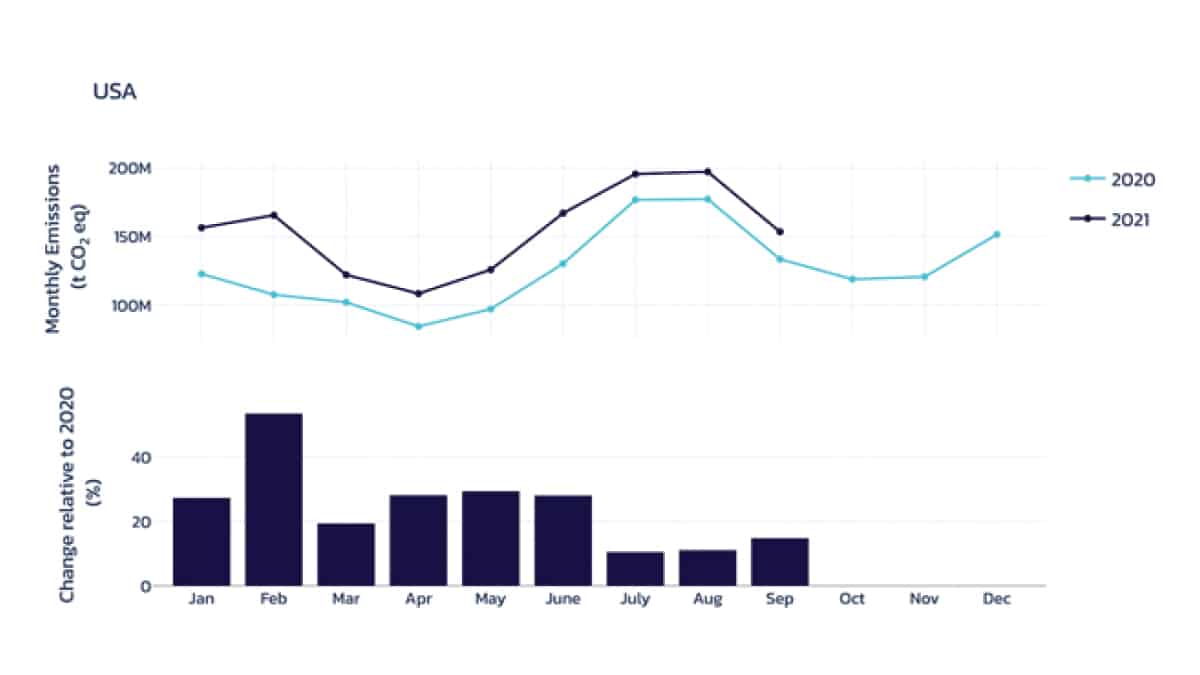
Climate US Power Emissions
United States power sector emissions 2020 vs. Q1–Q3 2021

Each group within Climate TRACE specializes in one anthropogenic sector, but we are sharing all these findings to create a truly global system that is available and free for everyone via the Climate TRACE website.

Unveiling timely and granular global emissions data for the first time

In September 2021 we released our inaugural inventory covering every country in the world through 2015–2020, spanning 10 sectors and 38 subsectors. These data revealed several striking insights about recent emissions trends, for example:

  • Steel production globally resulted in 13.1 billion tons of CO2e between 2015 and 2020, equivalent to the total emissions of Japan and the United Kingdom combined over that same period.
  • Shipping and aviation together emitted nearly 11 billion tons of CO2e between 2015 and 2020, totals that would make these two sectors combined the 5th largest emitter in the world, if they were a country.
  • Rice emissions are higher than previously thought in several countries, and in India’s case may be nearly 3 times the most recent official inventory from 2016.
  • In oil and gas production and refining, among the world’s top countries that submit regular inventories, emissions from oil and gas may collectively be around double (1 billion tons higher than) recent UNFCCC reports.
  • Further, it is likely that over 1 billion additional tons CO2e per year, more than the annual emissions of the 100 lowest-ranking emitting countries combined, have gone uncounted by countries that aren’t required to report their oil and gas emissions regularly.

An accompanying report was released soon after in early November, ahead of the COP26 negotiations. This report identified specific aspects of our earlier analysis that allow for more detailed and actionable insights about emissions:

  • Although accounting frameworks attribute emissions to certain entities — whether countries or corporations — in practice, all emissions come from specific sources: power plants, ships, factories, etc. That’s why asset-level granularity and the ability to ‘zoom in’ on a specific source and its emissions are central to our roadmap for Climate TRACE.
  • Measuring emissions from specific assets is dependent on knowing those assets exist in the first place. Yet in some instances, the existence of important sources of emissions remain undocumented. Climate TRACE data will put these emissions sources on the map for the first time. For example, concentrated animal feeding operations (CAFOs) are a major source of methane emissions. Attempts to regulate them have largely failed, because knowing how many of these facilities there are or where they are located remains opaque. Climate TRACE modeling contributor Synthetaic is using high-performance computing, generative AI, and deep neural networks to map CAFOs from satellite imagery.
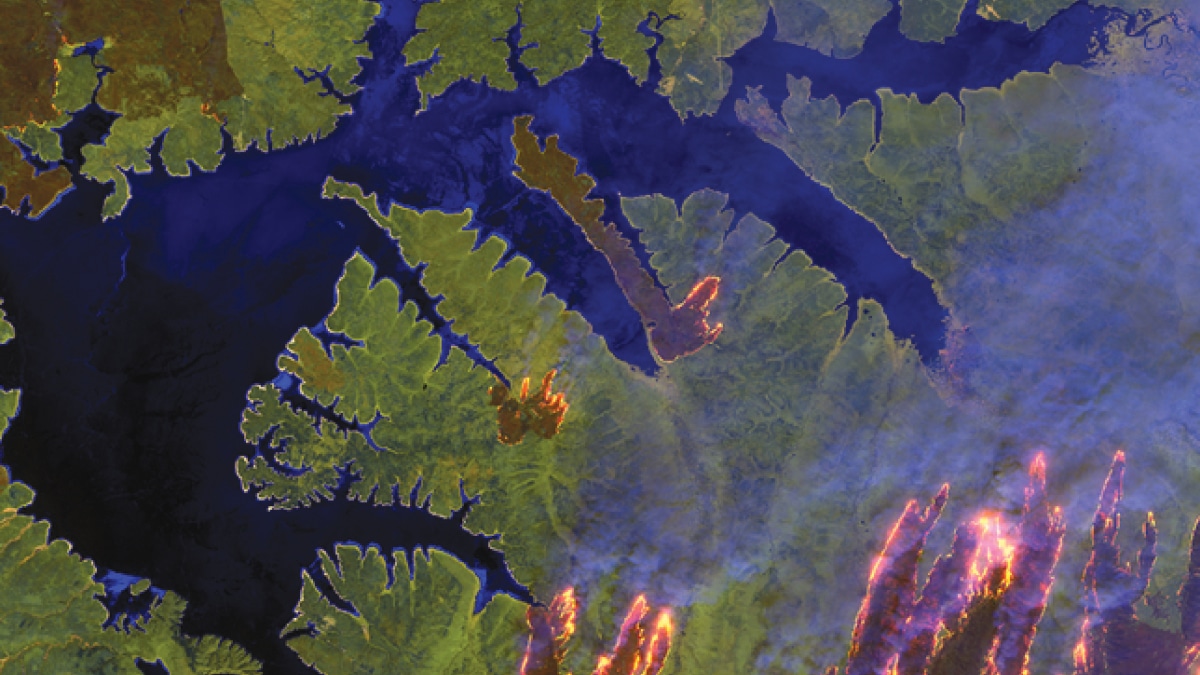
Climate Siberia Wildfires
Climate TRACE uses satellite data to estimate emissions from forest and cropland fires. Wildfires in Siberia, Sentinel-2

Constantly evolving data mean sharper, more recent insights

Because our algorithms are constantly learning and our methodology continues to evolve, we jump at any new opportunity to dig more deeply into timely and specific emissions trends. In the short span of time between the release of our inaugural inventory and our accompanying report, we explored and confirmed additional insights. For example:

  • Initial analysis of data from the first three quarters of 2021 by WattTime confirmed expected trends showing that power sector emissions rebounding in 2021 in places such as the European Union, United States, and India after 2020 declines due to COVID-related shutdowns. Later this year we plan to publish a full 2021 dataset to the Climate TRACE emissions inventory.
  • Typically, national emissions inventories are aggregated annual emissions numbers. For many sectors, Climate TRACE is documenting data on finer time scales, such as monthly or weekly emissions fluctuations from certain sectors and individual assets. For example, looking back at 2020 granular time-series data, OceanMind confirmed a sudden, sharp decline in maritime-related emissions as pandemic lockdowns and travel restrictions brought a temporary halt to the cruise ship industry.

Evolving the Climate TRACE dataset at the speed climate action demands

Since the release of our inaugural dataset, the Climate TRACE ecosystem has continued to expand rapidly with partners and contributors. The initial dataset has already started gaining traction among key users such as policymakers, nonprofits who want to encourage governments to make more ambitious mitigation plans, and research organizations. We recently launched the new STARRS project with Climate Group to provide GHG data to subnational governments around the world. As we continue to release even more detailed data on emissions sources, a wide range of businesses, activists, and investors will have the opportunity to use this never-before-available information to guide a variety of decisions.

Gavin McCormick is the Cofounder and Executive Director of WattTime. He is also one of the ten founding members of Climate TRACE, a global coalition of tech companies, NGOs, and universities working together to combine satellite imagery and artificial intelligence to make global GHG emissions transparent.

More Prime Read