Uncertainty looms across Europe, compounded by major geopolitical shifts, economic volatility, risk of impending energy crisis, and post-pandemic new normal adjustments. With the AEC sector geared towards stability, sustainability, and digital transformation, we look at the major trends shaping its future.
The introduction of BIM and GIS has catapulted the Architecture, Engineering, and Construction (AEC) industry towards a new direction.
External socioeconomic factors such as COVID-19, the Russia- Ukraine war, and disruptive supply chains have created obstacles. Now, while the need for sustainability gains prominence, the road to stability looks desolate for Europe’s AEC industry.
The technologies of tomorrow are up for grabs, and the AEC industry globally is taking advantage and developing rapidly by incorporating newer practices. While Europe’s AEC industry leads in digital technology adoption worldwide, within the region, it is the lowest-ranked economic sector in digital uptake. Digitalisation and the use of technologies, such as Building Information Modelling (BIM), Artificial Intelligence (AI), and Machine Learning (ML), are often politically and socially overlooked.
While there has been an increasing recognition within Europe’s AEC industry of the many benefits of advanced technologies there is still enough scope to further adopt advanced technology across infrastructure lifecycle projects.
As per an upcoming white paper titled Mega Trends Driving Digital Transformation in Europe’s AEC Industry, released by Geospatial World and prepared as a result of a thought-provoking discussion amongst the European members of the Autodesk-Esri Customer Council Group, here are four megatrends that affect the European AEC industry as a whole.
Sustainability
Climate change has been affecting every country; disrupting economies and the day-to-day lives of people. Subsequently, policies for the adoption of ethical production, construction, and consumption are being accelerated by governments worldwide. Major dialogues and treaties between governments such as the Paris Agreement have all called for gradual policy changes to incorporate more sustainable practices in every industry.
According to the white paper, “Sustainability in the AEC industry is defined as a dynamic relationship between developers of new solutions, investors, architects, engineers and contractors , professional consultants, industry suppliers, and other relevant parties towards achieving sustainable development goals.”
Sustainability in the AEC industry can be looked at from various perspectives. The ethical and greener approach to designing and managing buildings, choice of materials, and amalgamation of urban and economic development are some. Moreover, factors also change from country to country, as some focus on using their resources as efficiently as possible, whereas other countries might prioritise social inclusion and economic cohesion.
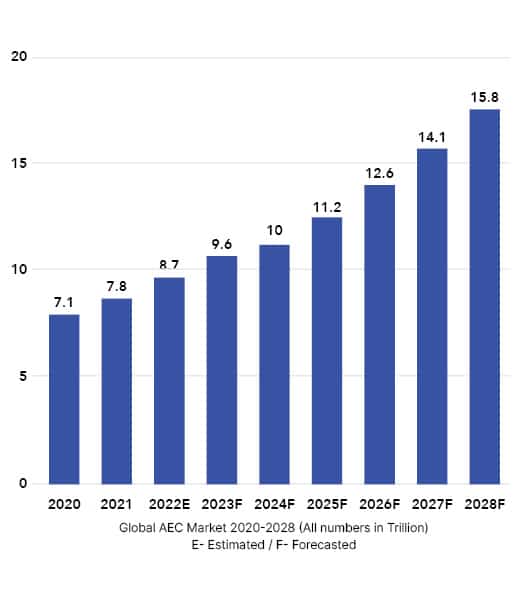
Digital Technology stands to improve the construction industry’s productivity as much as 60% – delivering as much as $1.6 trillion annually in incremental value.
The EU Roadmap
The European Union charted out five points for the construction sector to upkeep its sustainable competitiveness– investments, jobs, resource efficiency, regulation, and market access. The European Union’s policies for the AEC industry aim at an integrated approach to cover sustainability beyond low-carbon discussions, but for energy and resource efficiency, health, and safety issues.
“Alternatively, a paradigm shift has been occurring in the industry by adopting a Circular Economy model, which aims for restorative, regenerative, and disruptive design. In construction, circularity means reconfiguring the supply chain according to environmental sustainability criteria to address global resource scarcity and climate change,” the white paper report said.
This will make the built environment less resource-intensive, climate neutral, less polluting, and more resilient to the effects of climate change. The focus of Europe’s AEC industry is to promote the durability and adaptability of built assets in line with circular economy principles for building design and construction.
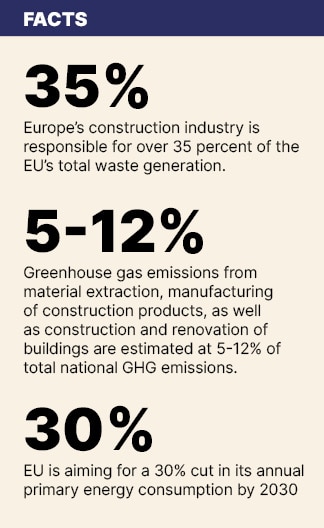
As adopting sustainable methods becomes more prominent; innovating, practicing, and implementing solutions at large would once again hinder the sail of the AEC industry in Europe. As of now, Europe’s construction industry is responsible for over 35 percent of the EU’s total waste generation. Moreover, the greenhouse gas emissions from material extraction, manufacturing of construction products, as well as construction and renovation of buildings are estimated at 5-12% of total national GHG emissions.
Incidentally, the EU is aiming for a 30% cut in its annual primary energy consumption by 2030, according to the white paper.
Geopolitical Risks
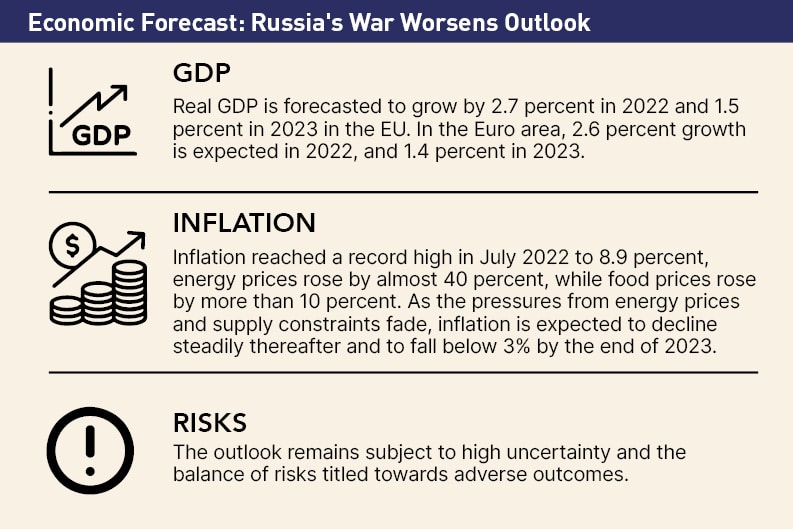
The Russia-Ukraine war has impacted the European AEC industry profoundly. The already complex supply chains have been disrupted, while a cloud of uncertainty still looms around. Stock market decline also aggravated the situation as the overall economic prowess of Europe showed no positive indices.
Signs of distress came into the picture soon after Russia started invading Ukraine. The euro sagged to a 20-year low against the dollar recession fears started inculcating economies, and a crisis seemed inevitable, all while the economies were rebounding from the Covid-19 slump. Most parts of the continent relied on Russia’s energy supply, while energy-intensive industries such as steel faced ambiguity at large.
“Europe’s construction continues to be deeply impacted by geopolitics especially in the background of the Russia-Ukraine war. Some of the geopolitical issues relate to nationalism, trade, supply chains, financing, labor, security, and the environment, affect the ability to complete projects, regardless of size or scope,” the white paper report said.
Europe’s War Dilemma
The European AEC industry has not yet completely shifted its heavy reliance from the insecure supply chains amidst the war. The disruption and search for an alternative supply-chain have translated into reduced demand within Europe’s construction industry, with many projects stalling, postponing or cancelling altogether. Russia being a major energy source for many European countries, rising energy prices will also prove to be another major factor that will once again disrupt the supply chain and increase material costs.
Moreover, Russia, Ukraine, and Belarus supply a sizeable proportion of Europe’s long steel products. The war interrupted production which translated into a steel squeeze. The war in the region has thus constrained not only the production and import of steel but steel mills across Europe. While the inflationary impact may be felt in the medium term, the geopolitical shifts are likely to have longterm effects which could shape new regionalised trade models.
Economic Volatility
The construction industry is one of the most volatile and failure-prone. With razor-thin margins and a complex and cash-hungry payment structure, construction companies can be among the first to feel the effects of economic uncertainty or poorly made bets in an economically volatile market. Volatility in economies across Europe shot off the roof due to Covid-19 and the subsequent lockdowns. As projections seemed to gain a few green points, the Russia- Ukraine war propelled the economies into another major collapse. Now, the talks of another major worldwide recession are making rounds, and both, the investors and the government are treading the pasture carefully.
Economic Uncertainty
Economic uncertainty has been looming around world economies for a while and due to the cash crunch, and tightly regulated monetary policies, the construction industry is facing significantly more volatility. The COVID-19 pandemic provoked an unprecedented economic crisis, with European Union GDP contracting by 5.9 percent in 2020.
“Local market structures and ease of entry in the European AEC space have resulted in a fragmented landscape (both vertically and horizontally). Additionally, the regional economic disruption has limited the economies of scale for mostly all small AEC companies. Alternatively, high unpredictability and cyclicality have led Europe’s AEC industry to rely on temporary staff and subcontractors, which is hampering productivity, limiting economies of scale, and reducing output quality and customer satisfaction,” the white paper report said.
Post-Pandemic Workforce Trends
Even though the grave effects of the COVID-19 slump started to diminish in Europe’s economy, the shift in working trends has been ravaging many industries, more so seriously in the AEC. The concerns and viability of the hybrid workforce environment are taking a u-turn, as productivity is limiting. The ability to meet job demands has also taken a hit as the new normal shows its true nature.
Post-Covid Human Resource Challenges
A quarter of construction companies are facing a scarcity of skilled design and construction workers in several Member States, including Germany, Austria, Spain, etc. “Europe’s AEC industry is finding it challenging to retain qualified workforce, causing significant project delays and cancellations, loss of project bids, and failure to innovate. Thus, there is a need for the regions’ AEC industry to realise remote work and virtual collaborations are here to stay to make the industry more efficient, collaborative, and flexible”, says the white paper.
Uncharted Area
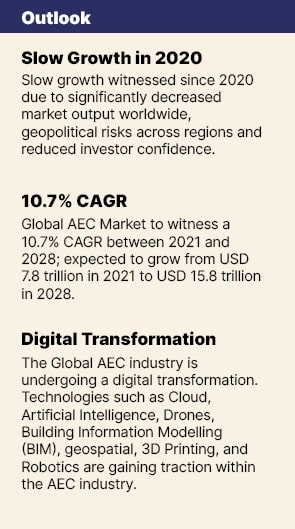
Digitalization in Europe’s AEC industry is driven by the need for sustainability and resiliency in infrastructure projects, not technology innovation. The halfhearted attempts at incorporating new methods and shedding off the traditional practices have begun to impede the European AEC’s spirited future.
The European AEC industry has some uncharted potential when it comes to digitalization across various project lifecycles. This brings out the need to shift from linear economic models to circular economic models – leveraging the power of data, technology and other digital solutions to move beyond the ecological boundaries.