Geospatial technology, complemented by advances in digital technologies, especially the combination of mobile, machine-to-machine and data analytics, will play a big role in enabling Circular Economy practices.

In today’s linear economy, manufacturers work around the take-make-waste model, where natural resources are extracted to create products, and products are disposed when they’re no longer useful. Such model is costly, not only in terms of economic value, it also imposes great loss to the environment.
Circular Economy, on the other hand, ensures that everything has value and nothing is wasted. Products are designed and made to last. Manufacturers adopt reuse-repair-reproduce model, enabling materials to remain in use at their highest value for as long as possible.
Circular Economy requires products to be connected digitally to the manufacturer so the entire product lifecycle can be monitored. The complex circular networks connecting suppliers and partners, too, must be managed seamlessly in order to support Circular Economy collaborative model. Advances in digital technologies, especially the combination of mobile, machine-to-machine and data analytics, will play a big role in matching the supply and demand of underused assets and products.
These are the 5 ways Geospatial technology is supporting and has the potential to support Circular Economy practices:
- Supply chain transparency and traceability: In order to use recycled materials repeatedly, it is important to have unprecedented insights into the end-to-end supply chain. Geospatial technology offers interactive visualization of big datasets from raw material to distribution, including extended supply chain discovery, risk analysis, transaction history, and others.
- Reducing waste: Recycling is key to reducing waste. In order to create an efficient recycling system, waste has to first be visible, verifiable and valuable. Geospatial technology, complemented by AI and ML, can offer insights into material types, amounts, concentrations, and movements of waste that will benefit waste producers, recyclers, investors and governments.
- Extending product lifetime: As consumer preference now shifts towards pay-per-use instead of ownership-based model, businesses need to maintain products for longer and offer new services to keep their competitive advantage. Taking example of pay-per-use car service, technologies such as GPS Telematics and IoT are imperative in providing predictive maintenance, fuel efficiency support, driving behavior report, etc. within this emerging business model.
- Recycling/Buyback campaign: In order to minimize environmental impacts in ways that will generate customer loyalty, businesses can use GIS and geo-targeting technology to map their customers in certain area and initiate either a buyback campaign or recycling drop-off campaign at specific phases of product ownership cycle. The rebought/dropped-off products can be fed back into the production cycle as raw material for a new generation of products.
- Maximizing the use of underused assets: Sharing economy platforms such as Airbnb, Uber, and Neighbor have demonstrated the best solutions to underused assets. Location data is critical to these platforms in order to match the nearest suppliers to consumers.
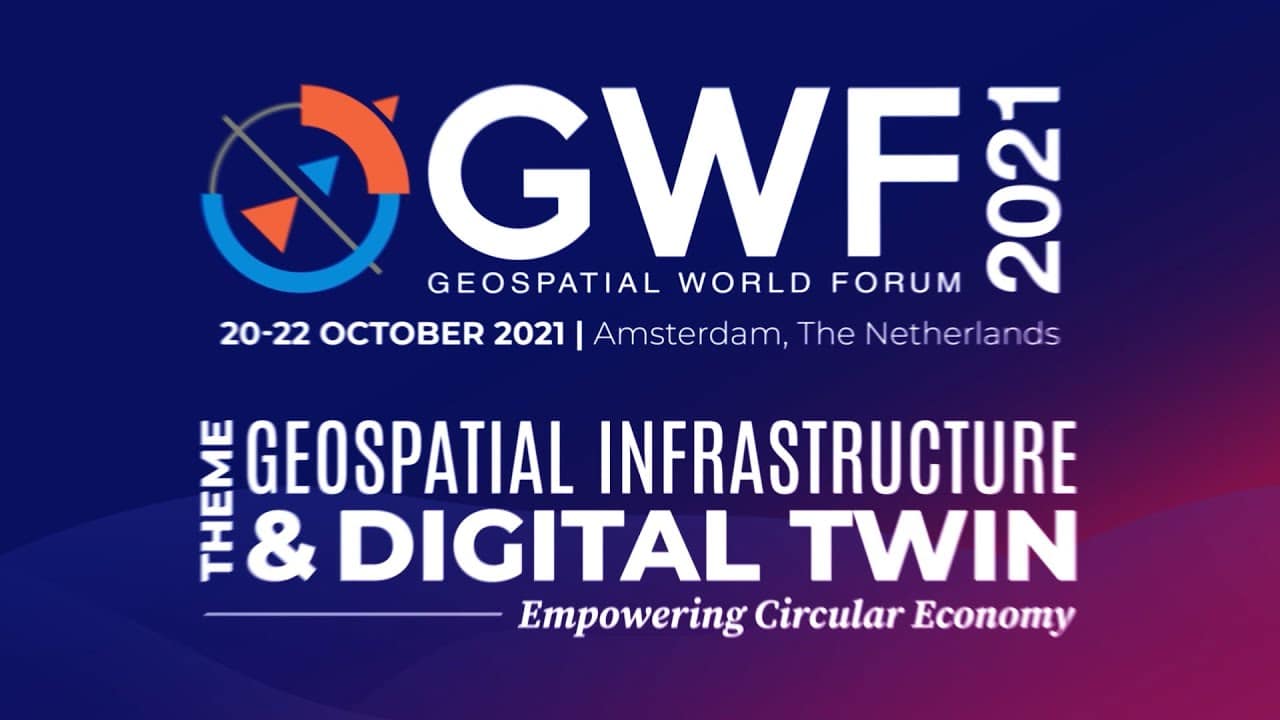
Geospatial World Forum 2021, scheduled from 20-22 October 2021 in Amsterdam will carry a strong focus on Circular Economy. With the theme Geospatial Infrastructure & Digital Twin: Empowering Circular Economy, the 3-day in-person event will discuss the role of Geospatial Infrastructure in fueling development of National Digital Twin, and how Geospatial-enabled National Digital Twin can contribute to achieving the Circular Economy vision.
A 2-day symposium on SDG & Circular Economy, scheduled for 21-22 October 2021, will dive further into this topic, with the objective to demonstrate how Circular Economy practices can help to achieve the Sustainable Development Goals (SDGs), and the promising role of Geospatial solutions in this regard.
The symposium will cover, among others:
- SDG 12 & Circular Economy: Ensuring Responsible Consumption and Production Patterns
- Geospatial & Circular Business Models
- Circular Agriculture: Rethinking Agricultural Value Chains to Prevent Food Loss
- Circular Economy & Net-Zero Emission Target
- Social Innovation and Collaborations towards Circular Cities
CLICK HERE TO REGISTER.